Does a larger dose of Botox for square jaw provide better results?
2026-09-16
The dosage of Botox for square jaw is determined differently for each person based on the development of the masseter muscle.
100 units do not necessarily provide double the effect of 50 units.
To achieve the desired effect, it is essential to first assess the condition of your muscles.

Hello, this is Derna Clinic.
When consulting about Botox for square jaw, questions regarding dosage are a significant concern.
"Do I need to get 100 units?"
"Is 50 units not enough?"
These are natural questions to have during a consultation. If it’s the same procedure, it seems logical that a larger dosage would yield greater effects. However, this is not necessarily the case with Botox for square jaw. Finding the appropriate dosage for your jaw muscles is more important than simply getting a larger amount.
Today, we will discuss why the dosage of Botox for square jaw varies from person to person, and we will examine the differences between 50 units and 100 units.
Why does the dosage of Botox for square jaw differ among individuals?
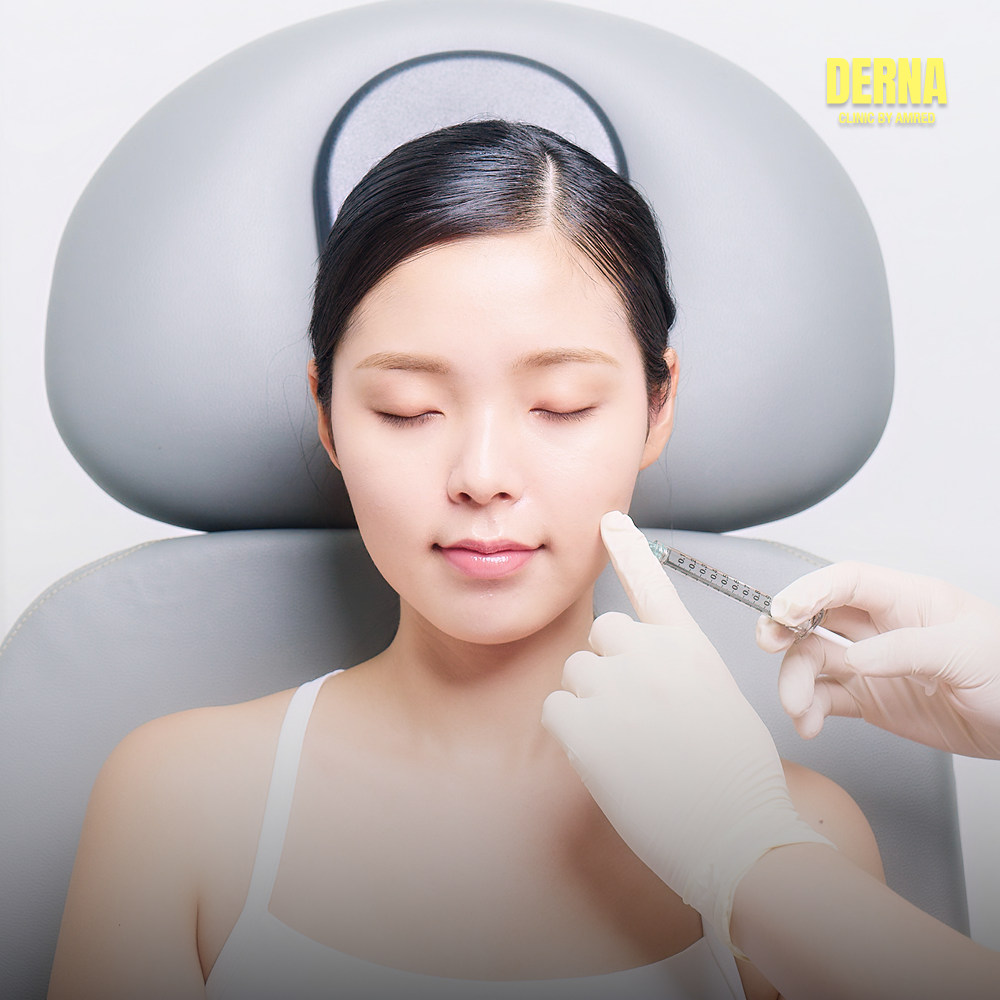
Botox for square jaw is administered to the masseter muscle, which is used for chewing. The size of the masseter muscle varies from person to person. Individuals who have a habit of clenching their teeth, grinding their teeth, or frequently tensing their jaw often have a thicker and more developed masseter. Conversely, some individuals may have smaller muscles.
Therefore, the dosage of Botox for square jaw cannot be uniformly applied to everyone. This is also true for men; it is not that men necessarily require a larger amount, but rather that the dosage can be determined after assessing how developed their masseter is.
What are the differences between 50 units and 100 units of Botox for square jaw?
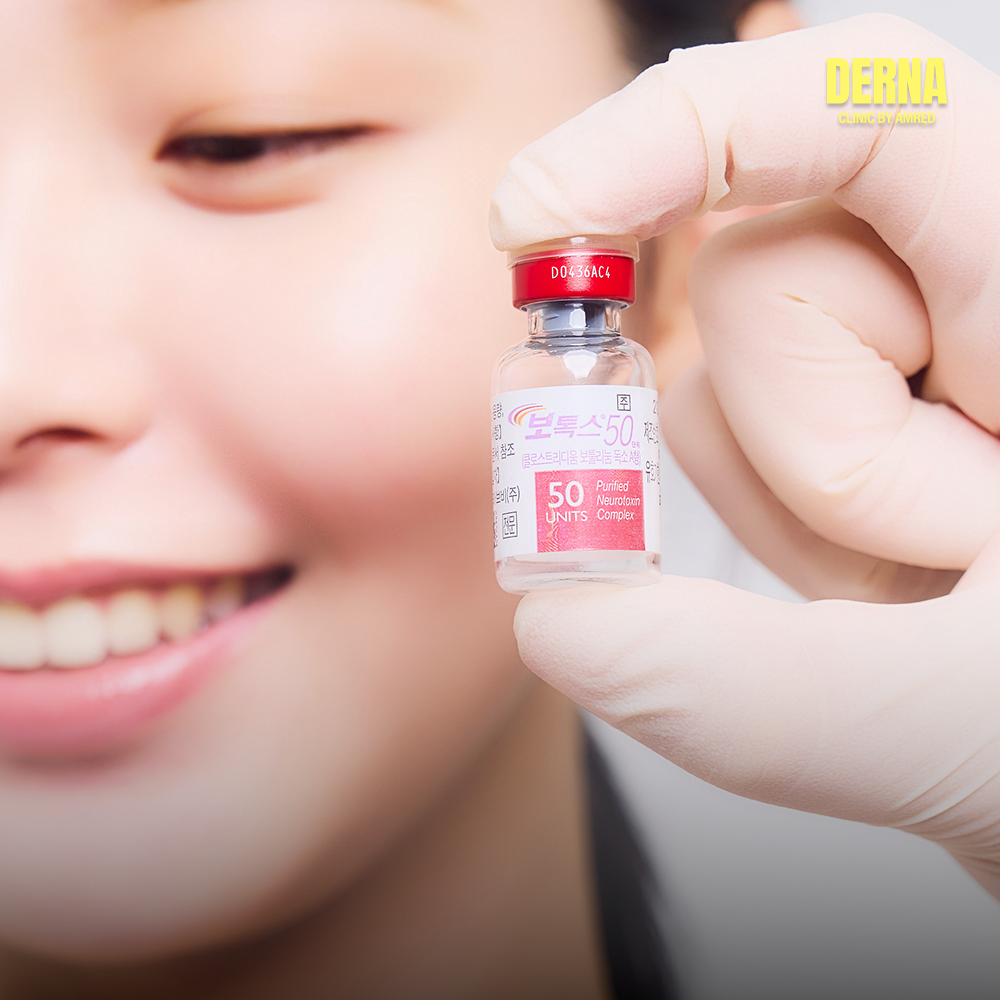
When simply comparing 50 units and 100 units of Botox for square jaw, it may seem that 100 units, being double the dosage, would provide double the effect. However, in reality, dosage and effect do not have a direct proportional relationship. The decision on whether to consider 50 units or 100 units can be made by assessing the size and development of the masseter, and if there is a difference in muscle condition on either side, the dosage can be adjusted accordingly.
However, this is not an absolute standard, and it is important to note that it can vary depending on the type of product used and the individual's muscle condition.
🔖 Derna Clinic TIP
Is there a difference between units and cc?
Since clinics express Botox dosage in either units or cc, it can be confusing. The two units have different meanings. Units refer to the amount of Botox, while cc indicates the volume of the diluted injection solution.
What happens if the Botox dosage for square jaw is too much or too little?

If too much dosage is administered relative to the muscle size, it can lead to discomfort while chewing or cause excessive reduction in facial volume, making the cheeks appear sunken, resulting in undesired changes. Conversely, if the masseter is well-developed but the appropriate dosage is not administered, you may not experience the expected changes.
Therefore, it is crucial to assess the degree of muscle development from the start and design an appropriate dosage. If changes are felt slowly after the procedure, it is advisable to consult with the clinic to check your condition.
Frequently Asked Questions
Q. Is there a significant cost difference between 50 units and 100 units of jaw Botox? What is the average price range?
The cost of jaw Botox varies based on the number of units used and whether the product is domestic or imported. You can check the price of jaw Botox at Derna Clinic in real-time on the event page below.
※Events may change or end without notice. If you cannot find the information you are looking for, we will provide detailed guidance upon inquiry.
Q. When I say "I will get 50 units" during the consultation, does that refer to the total dosage for both sides or the dosage for one side?
The criteria for explaining dosage may vary by clinic. Some places explain based on one side, while others explain based on the total for both sides, so it is advisable to confirm whether it is "total dosage" or "dosage per side" when comparing estimates.
Q. If the size of the jaw muscles on both sides is significantly different, can the dosage be adjusted to be different for each side?
If there is a habit of chewing on one side, there may be a difference in the development of the masseter on either side. If this asymmetry is confirmed, rather than administering the same dosage on both sides, it can be adjusted by allocating a relatively larger dosage to the more developed side.
Q. If after 1-2 weeks post-procedure, some muscles bulge when I clench my teeth, does that mean the dosage was insufficient?
This phenomenon occurs when the Botox has not yet acted on certain muscle areas or when adjacent muscles appear relatively prominent, and it does not necessarily indicate insufficient dosage. It can also be a temporary change that occurs depending on the injection range, depth, and overall muscle response speed. If certain areas continue to appear prominent after 2-4 weeks, when the overall muscle response has stabilized, it is advisable to check directly with the clinic where the procedure was performed.
Q. I am worried about hollow cheeks; will simply reducing the dosage prevent cheek hollowness?
Cheek hollowness cannot be prevented merely by reducing the dosage. It can be influenced by several factors, including the amount of facial fat, the size and shape of the masseter, and the injection layer and location. Therefore, if you are concerned about cheek hollowness, it is recommended to assess the facial structure and muscle condition at Derna Clinic before planning the procedure rather than just reducing the dosage.
Q. If a month has passed after the procedure and I can still feel my jaw muscles, does that mean the dosage was insufficient?
Botox is not a procedure that eliminates muscles; rather, it reduces the movement and contraction of muscles, making them smaller. Therefore, it is normal for the masseter to still be somewhat palpable after the procedure.
The effects typically begin to appear gradually around 2 weeks post-procedure, with muscle responses stabilizing around 4 weeks. If there is not much difference when clenching your teeth a month after the procedure compared to before, it could indicate insufficient dosage or a slower muscle response. It is advisable to check the muscle condition around 4 weeks and consult with the clinic where the procedure was performed for an accurate assessment.
At Derna Clinic, we provide personalized consultations to create a treatment plan tailored to your jaw muscle condition and concerns.
If you are considering Botox for square jaw, it is advisable to first get an accurate diagnosis of your jaw condition rather than just deciding on how many units to get.

10AM - 10PM EVERYDAY
SKIN. LOVE. LIFE
DERNA